
November 17, 2026
Rivet Nuts in Sheet Metal Assemblies: Installation Mechanics, Material Selection, and Pull-Out Validation
A technical guide for engineers and procurement teams on how rivet nuts work, how to choose materials and platings, and how to validate pull-out performance in sheet metal assemblies.
What rivet nuts do in a sheet metal assembly
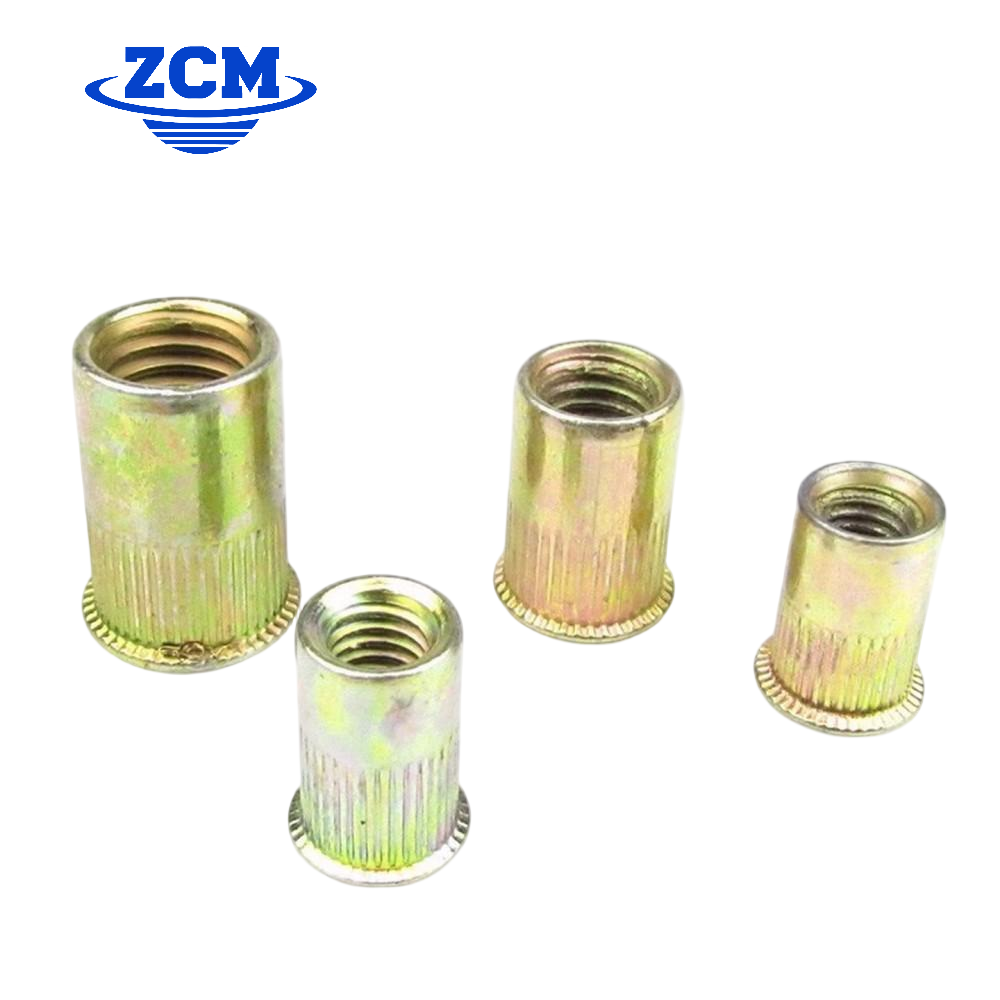
A rivet nut—also called a blind nut, threaded insert, or nutsert—is a tubular fastener with an internal thread and a deformable body. You insert it into a drilled or punched hole from one side of the sheet and compress it axially. The body collapses outward on the blind side, clamping the sheet between the head and the formed bulge. The result is a permanent, load-bearing thread in thin material that would otherwise be too thin to tap reliably.
That single-sided installation is the reason rivet nuts appear in enclosures, brackets, panels, and chassis where the back face is inaccessible after assembly. The trade-off is that the joint's strength depends on the sheet, not just the fastener. A rivet nut does not reinforce the sheet; it concentrates load into an annulus around the hole. Understanding that load path is the basis for every material and validation decision that follows.
Installation mechanics: what actually happens when you set a rivet nut
Setting a rivet nut is a controlled plastic deformation process. The tool pulls a mandrel or draws a stud through the nut body while the head is held against the front face. Three things happen in sequence:
- Hole fill. The unthreaded shank expands radially until it contacts the hole wall. Grip depends on how closely the shank diameter matches the hole.
- Bulge formation. Continued axial compression folds the body outward on the blind side. The bulge diameter and the clamp length determine resistance to pull-out and to rotation.
- Elastic springback. When the tool releases, the sheet and the formed bulge relax slightly. Residual clamp load holds the joint together.
Two failure modes originate here. If the hole is too large, the shank never fills it, the bulge forms unevenly, and pull-out strength drops. If the hole is too small, the shank binds, the tool force rises, and the sheet can distort or the nut can crack at the transition radius. Hole tolerance is therefore a first-order purchasing variable, not a secondary detail.
Grip range and sheet thickness
Every rivet nut has a grip range: the minimum and maximum total material thickness it can clamp. Using a nut outside its grip range produces either an incomplete bulge (too thick) or a bulge that forms behind the tool rather than against the sheet (too thin). Procurement should confirm that the specified grip range brackets the actual sheet thickness plus any coating or shim. A nut at the edge of its range may pass a visual check and still fail a pull-out test.
Tooling and setting force
Manual, pneumatic, and hydraulic setting tools differ in force repeatability. Manual tools depend on operator feel and are difficult to control on high-volume lines. Pneumatic and hydraulic tools with adjustable stroke give more consistent bulge geometry. For engineering approval, the setting tool is part of the process specification: record the tool model, stroke setting, and any calibration interval. A nut that passes validation on one tool may not reproduce on another.
Material and plating selection for rivet nuts
Rivet nut selection is a three-way balance between sheet material, environmental exposure, and galvanic compatibility. The nut body must deform without cracking, and the installed joint must resist corrosion for the service life of the assembly.
Body materials
- Steel (often low-carbon). Good formability and high strength after setting. Requires plating for corrosion resistance. Suitable for general enclosure and bracket work in dry or intermittently humid environments.
- Stainless steel (commonly A2 or A4 families). Better corrosion resistance and suitable for outdoor or washdown exposure. Stainless is less ductile than low-carbon steel in some grades, so setting force and hole tolerance must be controlled to avoid cracking. Confirm the specific grade and condition with the supplier rather than assuming all stainless behaves alike.
- Aluminum. Lightweight and corrosion-resistant in many environments, but lower shear and pull-out strength than steel. Useful where weight matters and loads are modest. Galvanic isolation from steel or stainless sheets may be needed.
Platings and coatings
Zinc plating is the common default for steel rivet nuts. Hot-dip galvanizing offers thicker zinc for outdoor service but adds thickness that can affect thread fit and hole clearance. Zinc-nickel and other alloy coatings are specified where higher corrosion demand exists. For stainless and aluminum bodies, plating is usually unnecessary, but a dry-film lubricant or anti-galling treatment may be specified to prevent thread seizure during bolt installation.
Two procurement checks matter here. First, plating thickness on the internal thread reduces the minor diameter; confirm that the specified bolt still assembles to the required torque without thread stripping. Second, coating damage during setting exposes bare metal at the bulge. If the application is corrosion-critical, specify a coating system that tolerates deformation or plan for post-installation touch-up.
Galvanic compatibility
When the rivet nut and the sheet are dissimilar metals, moisture creates a galvanic couple. The less noble metal corrodes. Aluminum nuts in steel sheets and steel nuts in aluminum sheets are common examples. Options include selecting a closer galvanic pair, using an isolating washer or sealant, or specifying a coating that limits electrical contact. This is a design decision, not a purchasing one, but procurement should flag any mismatch before order release.
Pull-out validation: how to prove the joint works
Pull-out strength is the axial force required to pull the installed nut through the sheet. It is not a single catalog number; it depends on sheet material and thickness, hole size, nut size and material, and installation quality. Validation should reproduce the production joint as closely as possible.
Test specimen preparation
- Use the same sheet alloy, temper, and thickness as production.
- Drill or punch holes to the specified diameter and deburr consistently. Note whether holes are punched or drilled; the edge condition affects results.
- Install with the production tool and stroke setting.
- Record nut lot, plating, and installation date.
Test method
A tensile test pulls the nut axially while the sheet is supported around the hole. The fixture must allow the bulge to bear on the sheet without adding friction that inflates the result. Load rate should be slow and steady, and the failure mode should be recorded: nut pull-through, thread stripping, sheet tearing, or nut fracture. Each mode points to a different corrective action. Thread stripping suggests the bolt or nut thread is undersized; sheet tearing suggests the sheet is too thin or the hole too large; nut fracture suggests a material or setting-force problem.
For a statistically meaningful validation, test a sample from each production lot and report the minimum, not just the average. A single passing test does not establish a process. Where the application is safety-related, the acceptance criterion should be set by the design engineer with an appropriate margin, not by the fastener supplier alone.
What pull-out testing does not cover
Pull-out is an axial test. It does not measure resistance to torque, vibration loosening, or combined loading. If the joint will see rotation during bolt tightening or service vibration, add a torque test and a vibration test. A nut that passes pull-out can still spin in the sheet under torque if the hole is oversized or the bulge is incomplete.
Comparison: rivet nut options at a glance
| Body material | Relative pull-out strength | Corrosion resistance | Formability / setting risk | Typical use |
|---|---|---|---|---|
| Low-carbon steel, zinc plated | High | Moderate (depends on plating thickness) | Good; low cracking risk | General enclosures, brackets, indoor assemblies |
| Stainless steel (A2/A4 family) | High | High | Lower; cracking risk if hole or stroke is off | Outdoor, washdown, corrosive exposure |
| Aluminum | Moderate to low | Moderate to high (grade dependent) | Good | Weight-sensitive panels with modest loads |
The table is a starting point, not a specification. Actual values depend on sheet thickness, nut size, and installation quality, and should be established by test for the specific joint.
Common failure modes and inspection points
Most rivet nut problems are visible before a pull test. A first-article inspection should check the following:
- Bulge symmetry. An uneven bulge means the tool was misaligned or the hole was oversized. It reduces both pull-out and torque resistance.
- Head seating. A gap under the head indicates incomplete setting or a burr on the sheet. The nut will rock under load.
- Thread condition. Cross-threading during setting or plating buildup in the thread will cause bolt installation problems downstream.
- Sheet distortion. Dimpling around the hole suggests excessive setting force or a sheet that is too thin for the nut size.
- Cracks at the transition radius. More likely with stainless bodies and high setting force. A cracked nut can pass a casual visual check and fail in service.
For incoming inspection, a go/no-go thread gauge and a visual check under low magnification catch most defects. Destructive pull-out testing on a sample per lot confirms the process has not drifted.
Procurement specification checklist
When issuing an inquiry for rivet nuts, include enough detail that the supplier can quote the correct part rather than a nearest equivalent:
- Thread size and pitch, and the class of fit required.
- Body material and grade, with the standard or specification referenced.
- Plating or coating type and minimum thickness, especially on the internal thread.
- Grip range bracketing the actual sheet thickness.
- Hole diameter and tolerance for the sheet.
- Head style (flat, countersunk, small flange) and any flushness requirement.
- Setting tool interface and any stroke or force limits.
- Validation requirement: sample size, test method, and acceptance criterion.
- Lot traceability and documentation expectations.
Vague inquiries invite substitutes that may meet the drawing but not the joint. The cost of a failed pull-out test on the line is usually higher than the price difference between a specified nut and a generic one.
Where rivet nuts fit relative to other sheet metal fasteners
Rivet nuts are not the only way to put a thread in sheet metal. Self-clinching nuts require access to both sides and a press. Weld nuts require weldable sheet and leave a visible mark. Self-drilling screws cut their own hole and are not reusable. Rivet nuts win when access is one-sided, the sheet is thin, and the joint needs a serviceable thread. They lose when the sheet is too thin for the nut's grip range or when pull-out loads exceed what the sheet can carry without a doubler plate.
For assemblies that combine rivet nuts with other threaded components, keep the thread standards consistent across the bill of materials. A rivet nut specified to a metric coarse thread should mate with a bolt of the same standard and property class; mixing standards is a common source of field assembly problems.