
August 11, 2026
Precision Cold Rolled Thread Bolt Smooth Matching Nut No Slipping Thread Under Long-Term Vibration
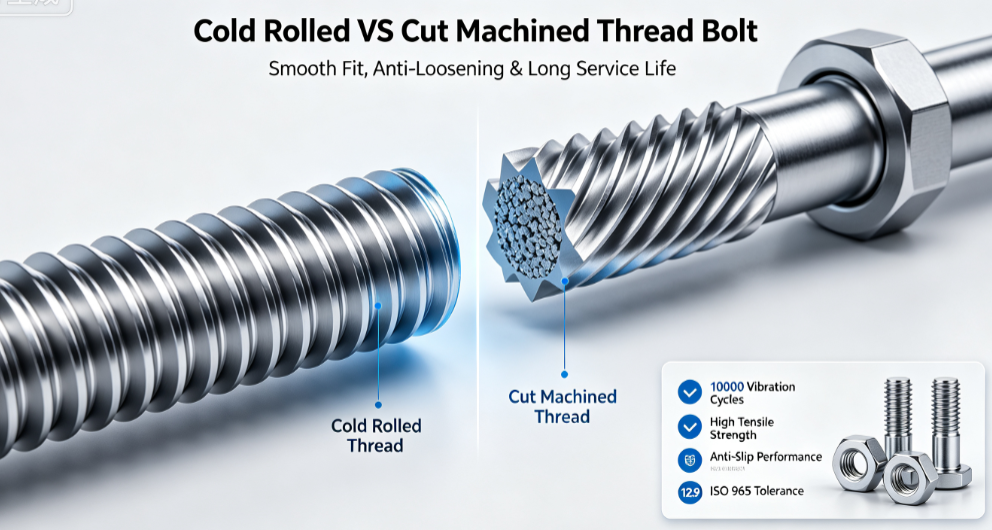
Table of Contents
1. Global Market Demand Growth of Cold Rolled Thread Fasteners (Verified Industrial Data)
2. Core Structural Advantages of Precision Cold Rolled Thread
3. 6 Key Performance Indicators For Qualified Cold Rolled Bolt & Matching Nut 3.1 Continuous Fiber Metal Structure Boost Fatigue Resistance 3.2 Ultra-Smooth Thread Surface & High Precision Tolerance Matching 3.3 Anti-Loosening, Anti-Slip Performance Under Long-Term Reciprocating Vibration 3.4 High Tensile & Yield Strength Without Thread Crack 3.5 Surface Anti-Corrosion Treatment & Salt Spray Durability 3.6 Uniform Tooth Profile, No Local Stress Concentration
4. Cold Rolled Thread VS Cut Machined Thread Bolt Performance Comparison Table
5. Standard Cold Rolling Production & Precision Thread Matching Process Flow
6. Main Application Scenarios With Continuous Vibration Working Condition
7. Step-by-Step Selection Guide For Fastener Distributors & Equipment Manufacturers
8. Common Failures Of Unqualified Machined Thread Fasteners In Vibration Environment
9. Industry FAQ For Cold Rolled Thread Bolt & Nut Sourcing
1. Global Market Demand Growth of Cold Rolled Thread Fasteners (Verified Industrial Data)
The global high-strength precision fastener market reached USD 11.6 billion in 2025, Dataintelo’s industrial forecast report shows, and will expand to USD 18.3 billion in 2033 with a CAGR of 5.8%. Cold rolled thread bolt and matching nut account for 41.7% of high-strength fastener shipment volume, the mainstream choice for vibration-intensive equipment manufacturing.
Transport machinery, new energy equipment and industrial automation equipment are three major downstream driving sectors. QYResearch statistical data records that new energy wind turbine, new energy vehicle and precision automation equipment demand for anti-slip cold rolled thread fasteners rose 17.2% year-on-year in 2025. Asia Pacific takes up 46% global fastener market share. Domestic wind power, EV production line expansion push massive bulk order growth of precision cold rolled thread bolt sets. Europe follows with 25% share, strict EU machinery vibration safety standards accelerate phase-out of low precision cut thread bolts.
Many equipment manufacturers previously used ordinary cut machined thread bolts. But long-term reciprocating vibration will cause thread slip, loose assembly and equipment shutdown failure. More OEMs switch to full cold rolled thread bolt-nut matching sets, which cut vibration-related maintenance downtime loss by over 40%. Ordinary lathe-cut thread fasteners only maintain stable clamping force for 800–1,200 vibration cycles, while precision cold rolled thread matching components can stand more than 10,000 vibration cycles without thread slipping or axial loosening.
2. Core Structural Advantages of Precision Cold Rolled Thread
Cold rolling thread forming is a plastic cold working process, different from cutting thread that removes metal material. Raw steel bar is extruded by high-hardness thread rolling dies to squeeze and form complete tooth profile, the internal metal fiber of steel remains continuous without breakage. This core structural feature brings two decisive strengths against vibration slip: First, unbroken metal fiber greatly improves thread fatigue resistance, avoid micro crack expansion under frequent alternating vibration load. Second, rolling process produces ultra-smooth thread flank surface, high dimensional tolerance consistency between bolt external thread and nut internal thread. The contact area between matching teeth increases evenly, friction locking force distributes uniformly on full thread length, no local tooth gap to trigger slip under vibration.
Cutting machining will cut off steel fiber at tooth root, form sharp stress concentration point, plus rough thread surface with irregular tooth clearance. Under long-time vibration, the clearance will expand continuously, lead to thread sliding and nut loosening gradually.
3. 6 Key Performance Indicators For Qualified Cold Rolled Bolt & Matching Nut
3.1 Continuous Fiber Metal Structure Boost Fatigue Resistance
Cross-section metallographic inspection standard: metal streamline continuously run through thread tooth root and tooth surface, no fracture or disconnection. Vibration fatigue test standard: 10,000 times reciprocating alternating vibration load test, no thread micro crack or tooth breakage. Cut thread parts have broken fiber, fatigue life drop 60% below cold rolled bolt.
3.2 Ultra-Smooth Thread Surface & High Precision Tolerance Matching
Thread surface roughness Ra ≤0.8μm after cold rolling. ISO 965 standard medium tolerance class 6H/6g full matching between bolt and nut. Tooth gap error controlled within 0.02mm full thread length. Uniform close contact between bolt and nut thread eliminates local clearance gap which is the root cause of vibration slip.
3.3 Anti-Loosening, Anti-Slip Performance Under Long-Term Reciprocating Vibration
Core signature advantage of cold rolled thread assembly. Test condition: horizontal reciprocating vibration frequency 50Hz, amplitude 1.2mm, pre-tightening force set at 70% yield strength. Qualified cold rolled matching set: after 10,000 continuous vibration cycles, residual pre-tightening force retention rate ≥85%, no relative thread sliding displacement between bolt and nut. Unqualified cut thread assembly residual clamping force drop below 40% within 1,200 cycles, obvious thread slip and nut offset occur.
3.4 High Tensile & Yield Strength Without Thread Crack
Cold rolling process produces tooth root cold work hardening effect. Same material grade cold rolled bolt tensile strength improves 12%~18% compared with cut thread bolt. Full tensile destructive test: fracture position occurs on bolt rod body instead of thread tooth root, no tooth root crack or collapse failure.
3.5 Surface Anti-Corrosion Treatment & Salt Spray Durability
Standard surface treatment options: zinc-nickel alloy plating, hot-dip galvanizing, Dacromet coating. Neutral salt spray test threshold: zinc-nickel plated cold rolled fastener ≥500h without red rust; Dacromet treated part ≥1000h salt spray standard, fit offshore wind, coastal new energy vehicle vibration equipment.
3.6 Uniform Tooth Profile, No Local Stress Concentration
Rolling die precision controlled tooth root circular arc R value, no sharp right-angle tooth root. Stress concentration factor reduced by 45% compared with cutting thread sharp root. Even load distribution on every thread tooth under vibration impact, prevent single tooth overload plastic deformation and thread slipping.
4. Cold Rolled Thread VS Cut Machined Thread Bolt Performance Comparison Table
Test Index | Precision Cold Rolled Thread Bolt + Matching Nut | Ordinary Lathe Cut Machined Thread Bolt | Vibration Equipment Application Impact |
Metal Fiber State | Continuous unbroken streamline | Cut off, fractured at tooth root | Cut thread easy to crack under long vibration |
Thread Surface Roughness | Ra ≤0.8μm smooth flank | Ra ≥3.2μm rough uneven surface | Uneven friction, clearance expand fast |
Vibration Anti-Slip Cycle Limit | ≥10,000 cycles, 85% residual pre-tightening force | Only 800–1200 cycles, residual force <40% | Frequent equipment loose failure & shutdown |
Tensile Strength Promotion | +12%~18% vs cut thread | Baseline reference value | Cut thread easy tooth collapse under dynamic load |
Tooth Root Stress Concentration | Low, rounded arc transition | High sharp right-angle root | Single tooth plastic deformation slip risk |
Matching Tooth Clearance Consistency | ±0.02mm full thread uniform gap | Irregular gap difference up to 0.1mm | Local gap creates slip starting point |
Service Life Under Reciprocating Vibration | 3–5 times longer | Short design life | Higher equipment maintenance frequency & cost |
Data reference: ISO 965 thread tolerance standard & fastener vibration fatigue comparative test report
5. Standard Cold Rolling Production & Precision Thread Matching Process Flow
1. High-strength alloy steel bar straightening, surface oxide removal pretreatment
2. Precision thread rolling die cold extrusion forming, strictly control rolling pressure and feed speed to maintain continuous metal fiber
3. Heat treatment quenching and tempering to reach designated strength grade (8.8 / 10.9 / 12.9 grade)
4. Thread surface finishing deburring, ensure Ra ≤0.8μm smooth tooth flank
5. Nut internal thread precision tapping with matched tolerance 6H, same tooth profile standard as bolt external thread
6. Surface anti-corrosion plating / Dacromet coating treatment, baking curing
7. Full batch sampling inspection: thread tolerance gauge test, vibration anti-slip test, salt spray corrosion test, tensile strength test
8. Sort bolt and nut by matching tolerance group for paired packaging, avoid mixed tolerance assembly causing abnormal tooth gap
Skip precise rolling parameter control or grouped matching sorting procedure, the finished bolt-nut set will lose anti-slip performance under long vibration.
6. Main Application Scenarios With Continuous Vibration Working Condition
1. New Energy Wind Turbine: Nacelle gearbox, tower flange, yaw drive vibration fastener sets, 20-year long-term alternating wind load vibration
2. New Energy Vehicle Chassis & Motor Assembly: Road bump reciprocating vibration, long service life requirement without thread slip
3. Construction Machinery Excavator & Loader: Engine, hydraulic pump mounting bolt-nut under frequent operation vibration impact
4. Industrial Automation Linear Motion Equipment: Reciprocating slide table, servo motor bracket continuous high-frequency vibration
5. Offshore Floating Equipment & Coastal Automated Machinery: Combine salt mist corrosion and long-term vibration dual harsh conditions
6. Railway Transit Vehicle Bogie Assembly: Train running periodic vibration, strict anti-loose thread safety demand
7. Step-by-Step Selection Guide For Fastener Distributors & Equipment Manufacturers
Step 1: Confirm equipment vibration working condition: vibration frequency, cycle life demand, load strength grade (8.8 / 10.9 / 12.9) Step 2: Choose cold rolled thread full matching bolt & nut set instead of separate mixed cut thread parts Step 3: Verify thread tolerance grade: standard 6g external thread for bolt, matched 6H internal thread for nut Step 4: Confirm ambient corrosion grade: inland dry workshop pick zinc plating; coastal / offshore wind select zinc-nickel or Dacromet coating Step 5: Request factory vibration anti-slip test report, check residual pre-tightening force retention rate after 10,000 cycles Step 6: Ask supplier to implement grouped tolerance matching packaging to prevent disordered tolerance assembly
8. Common Failures Of Unqualified Machined Thread Fasteners In Vibration Environment
1. Thread slipping & nut progressive loosening: Irregular large tooth clearance of cut thread expand under vibration, relative slide generate axial offset, equipment assembly loose.
2. Tooth root fatigue crack & thread breakage: Broken metal fiber and sharp stress concentration point lead to crack expansion after thousands of vibration cycles, safety accident risk.
3. Single thread tooth plastic collapse: Uneven friction load distribution, local tooth overload deformation, permanent thread matching failure.
4. Accelerated surface corrosion failure: Rough thread surface retain moisture and salt particle residue, corrosion pit expand to form new vibration stress concentration point.
5. Frequent equipment maintenance downtime: Repeated re-tightening work raise labor cost, production line stop loss for automation factory.
9. Industry FAQ For Cold Rolled Thread Bolt & Nut Sourcing
Q1: Why cold rolled thread assembly can prevent slipping thread under long vibration while cut thread cannot?
A1. Cold rolling keeps steel internal metal fiber unbroken and forms smooth uniform thread contact surface. The matching tooth clearance is consistent in full length, friction locking force evenly distributed on every tooth, no local gap to trigger slide under alternating vibration. Cutting process cuts metal fiber and creates irregular rough clearance, gap widen continuously to cause slip.
Q2: Is extra spring lock washer still needed if use precision cold rolled matching bolt & nut?
A2. For medium & low vibration static load equipment, single cold rolled matching set can meet anti-loose demand without lock washer. For high-frequency heavy vibration working condition (wind turbine, railway bogie), auxiliary anti-loose structure can be added for double protection, thread slip root cause will not occur from tooth matching side.
Q3: What strength grade cold rolled thread fastener most widely used for vibration equipment?
A3. 10.9 grade high-strength cold rolled bolt-nut set is mainstream for wind power, new energy vehicle and construction machinery; 12.9 grade for ultra-heavy load high vibration automation equipment; 8.8 grade for light vibration general automation assembly.
Q4: Can cold rolled thread bolt match ordinary tapping nut produced by cutting process?
A4. Not recommended. Ordinary cut tapping nut has inconsistent internal tooth roughness and tolerance, mismatch with cold rolled bolt external thread will form irregular clearance, lose anti-slip advantage under long vibration. Must select full cold rolling matched nut with same tooth profile and tolerance standard.
Q5: How many vibration cycles can qualified cold rolled thread matching set sustain without slipping?
A5. Standard qualified product passes 10,000 continuous reciprocating vibration cycles test, residual pre-tightening force retention above 85%, no relative thread sliding displacement between bolt and nut.