
June 23, 2026
Hex Expansion Bolt Selection Guide for Different Concrete Strengths
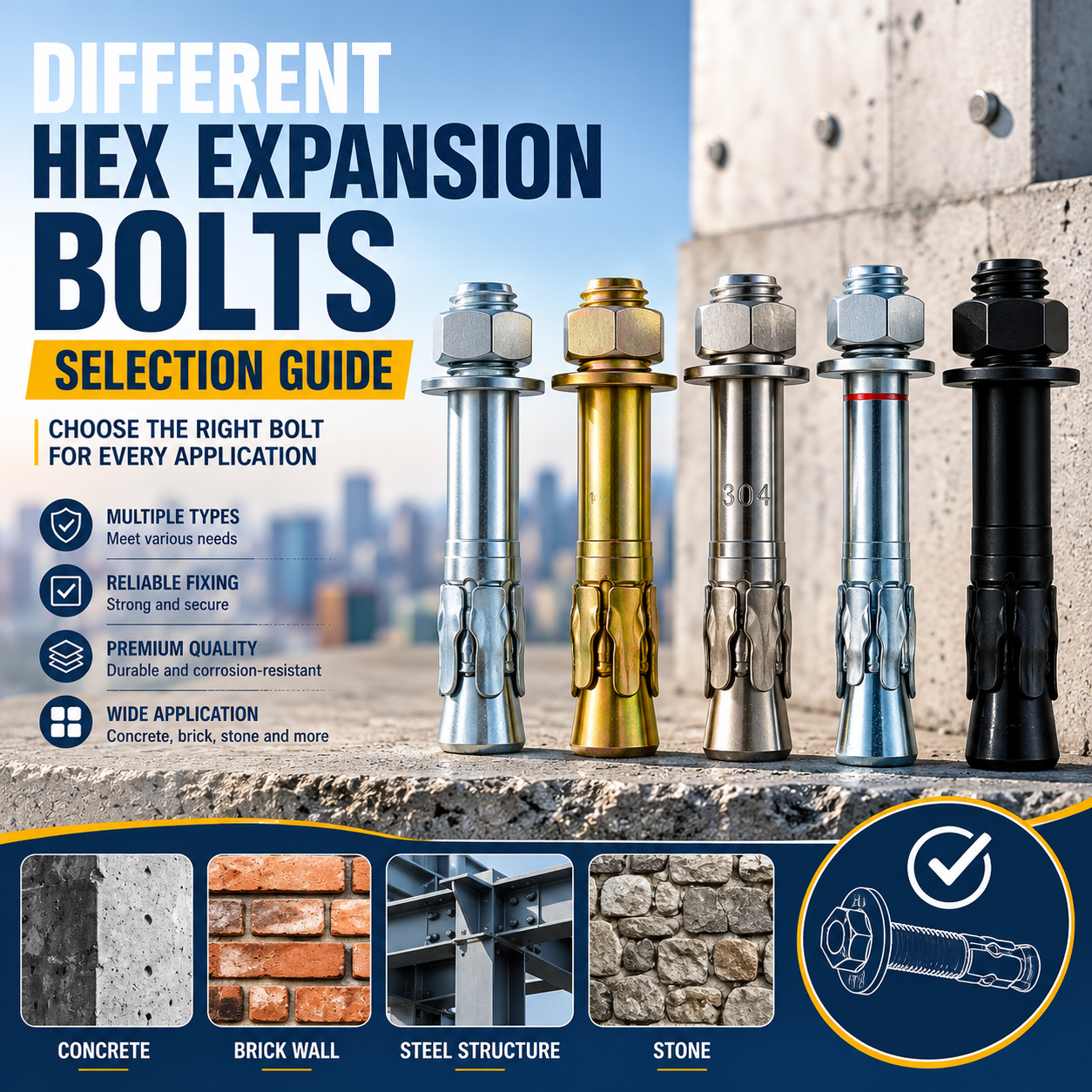
A site manager once showed me two identical M12 expansion bolts. One had been pulled out of C20/25 concrete during a load test. The other held firm in C50/60 concrete with the same embedment depth. Same bolt, same diameter, same installation procedure. The only difference was the concrete they were anchored into. The lesson was simple, but it had cost the project a re-engineered support system and two weeks of delay: concrete strength is not a background assumption. It is the primary input to anchor selection.
Hex expansion bolts transfer load to the base material through friction and mechanical interlock. The concrete resists this load through its compressive and tensile capacity. When the concrete is stronger, it resists more. When it is weaker, the same bolt carries less. This relationship is not linear—it follows the square root of the concrete compressive strength—but it is predictable. The selection process is about matching the bolt diameter, embedment depth, and concrete grade to the required design load.
How Concrete Strength Governs Anchor Capacity
The dominant failure mode for a properly installed expansion bolt in concrete is concrete cone failure. The characteristic resistance of a single anchor in cracked concrete is given by the formula that anchors the entire selection logic:
N_Rk,c = k1 × √f_ck × h_ef^1.5
In this equation, f_ck is the characteristic compressive cylinder strength of the concrete in MPa, and h_ef is the effective embedment depth in mm. The square root relationship means that doubling the concrete strength does not double the anchor capacity—it increases it by a factor of approximately 1.4. Going from C20/25 (f_ck = 20 MPa) to C50/60 (f_ck = 50 MPa) increases the concrete cone capacity by about 58% for the same bolt at the same embedment depth.
The practical implication is straightforward. If you are anchoring into low-strength concrete, you compensate with deeper embedment or larger bolt diameter—not by hoping the bolt performs better than the calculation predicts. If you are anchoring into high-strength concrete, you can achieve the same design load with a shallower embedment or a smaller bolt, which may reduce installation cost and edge distance requirements.
Concrete Strength Classes and Their Impact
Concrete is classified by its characteristic compressive cylinder strength at 28 days, expressed in MPa. The most common classes for structural applications are C20/25, C25/30, C30/37, C35/45, C40/50, and C50/60. The first number is the cylinder strength, and the second is the cube strength. Anchor design uses the cylinder strength, f_ck.
For a given bolt and embedment depth, the table below shows how concrete strength drives the design tensile resistance. These values assume a single torque-controlled expansion bolt in cracked concrete, with no edge or spacing influence. The characteristic resistance is calculated per the relevant design standard, and the design resistance applies a partial safety factor of 1.5. A further global safety factor of approximately 3.0–4.0 is then applied to reach the safe working load, depending on the application and the governing installation standard. The safe working loads in the following tables are calculated with a factor of approximately 3.5, which is representative for overhead and safety-critical installations.
Bolt Size | Embedment (mm) | C20/25 (kN) | C25/30 (kN) | C30/37 (kN) | C40/50 (kN) | C50/60 (kN) |
M8 | 55 | 8.5–10.5 | 9.5–12.0 | 10.5–13.5 | 12.0–15.5 | 13.5–17.5 |
M10 | 60 | 13.0–16.5 | 14.5–18.5 | 16.5–21.0 | 19.0–24.0 | 21.0–27.0 |
M12 | 70 | 16.5–22.0 | 19.0–25.0 | 21.5–28.0 | 24.5–32.0 | 27.5–36.0 |
M16 | 85 | 26.0–34.0 | 29.5–38.5 | 33.5–43.5 | 38.0–50.0 | 42.5–56.0 |
M20 | 100 | 38.0–50.0 | 43.0–56.5 | 49.0–64.0 | 56.0–73.0 | 62.5–82.0 |
Values are indicative design tensile resistance in kN for single anchors in cracked concrete without edge or spacing influence. Ranges reflect manufacturer-specific performance. Always verify against the anchor's ETA document for the specific product being specified.
Selecting the Right Bolt for Your Concrete Grade
The selection logic runs in three steps. First, determine the required design tensile load per anchor. Second, identify the concrete strength class from the structural drawings or from on-site testing. Third, select a bolt diameter and embedment depth whose design resistance exceeds the required load for that concrete class.
For an application requiring a design tensile load of 12 kN per anchor in C25/30 cracked concrete, the selection table above directs attention to the M10 and M12 rows. An M10 bolt at 60 mm embedment delivers approximately 14.5–18.5 kN design resistance in C25/30, which exceeds the 12 kN requirement. An M12 bolt at 70 mm embedment is also viable, delivering 19.0–25.0 kN, but requires a deeper hole and a larger edge distance. The M10 is the more economical choice for this load, provided the embedment depth is achievable in the base material and the edge distance requirements can be met.
For the same 12 kN requirement in C20/25 concrete, the M10 design resistance of 13.0–16.5 kN still exceeds the requirement, but the margin is smaller. If the concrete strength is uncertain—and on-site strength often varies from the design specification—the M12 provides additional headroom. This is a judgment call based on the confidence in the concrete quality, the consequence of anchor failure, and whether the installation will be proof-tested.
When anchoring into existing concrete of unknown strength, on-site pull-out testing is the most reliable method of verification. A sample of anchors is installed and tested to a specified proof load that exceeds the design load by a defined margin. The test confirms that the selected bolt and embedment depth are adequate for the actual concrete condition, regardless of what the original construction documents state.
Installation Factors That Influence Capacity
The calculation assumes the bolt is installed correctly. Several installation variables can reduce the actual load capacity below the calculated value.
Hole cleaning is the variable that separates tested performance from field reality. Concrete dust left in the hole reduces friction between the expansion sleeve and the hole wall. The standard installation procedure requires blowing the hole clean with compressed air, brushing with a wire brush, and blowing again. Skipping this step can reduce anchor capacity by 30% or more, particularly in deep holes and smaller diameters.
Torque control is critical for torque-controlled expansion bolts. Under-torquing leaves the expansion mechanism partially set, reducing the friction force. Over-torquing can strip the threads or fracture the concrete around the expansion point. A calibrated torque wrench is not optional equipment. It is the instrument that translates the manufacturer's specified installation torque into the design preload that the load calculation assumes.
Edge distance and spacing affect the concrete cone capacity. When anchors are placed closer than the critical spacing—typically 3.0 times the embedment depth—their concrete cones overlap and the group capacity is less than the sum of individual anchor capacities. When anchors are placed closer than the critical edge distance—typically 1.5 times the embedment depth—the concrete cone is truncated by the edge and the capacity drops further. These reductions are calculated using geometric adjustment factors per the applicable design standard.
FAQ
Q: How do I know the concrete strength of an existing structure?
A: Three methods exist. The most reliable is core sampling—extracting a concrete cylinder and testing it in compression per ASTM C42 or EN 12504-1. This is destructive and requires repair. Non-destructive methods include Schmidt rebound hammer testing, which provides an approximate surface hardness correlated to strength, and ultrasonic pulse velocity testing. Both should be calibrated against core samples from the same structure for reliable results. For critical anchorages, on-site pull-out testing of installed anchors is the definitive verification.
Q: Can I use the same bolt specification for different concrete grades?
A: Yes, but the load rating changes. An M12 bolt embedded 70 mm carries a higher allowable load in C50/60 concrete than in C20/25 concrete. The bolt itself is identical. The difference is in the concrete's capacity to resist the cone failure. If the project involves multiple concrete grades, specify the bolt based on the weakest grade present, or use different embedment depths per zone.
Q: What is the minimum concrete thickness for expansion bolts?
A: The minimum concrete thickness is typically 1.5 times the effective embedment depth, with a lower bound of 100 mm for most structural applications. Thinner concrete risks splitting failure through the back face. For a 70 mm embedment, the minimum slab thickness should be at least 105 mm.
Q: Does wet concrete affect expansion bolt performance?
A: Yes. Water-saturated concrete has reduced friction between the expansion mechanism and the hole wall, and the presence of water can reduce the effective bond in some anchor types. Standard expansion bolts are qualified for use in dry and damp concrete, but not for submerged conditions unless specifically rated. If the anchor will be installed in water-saturated or submerged concrete, select an anchor with the appropriate European Technical Assessment for those conditions.
Summary
Hex expansion bolt selection is a function of concrete strength, not just bolt diameter. The same bolt in stronger concrete carries more load. The same bolt in weaker concrete needs a larger diameter or deeper embedment to achieve the same capacity. The calculation is anchored by the concrete cone failure formula, which ties capacity to the square root of the concrete compressive strength.
For procurement and engineering teams, the practical rule is to specify the concrete strength class at the same time the bolt size is specified. A drawing that calls for an M12 expansion bolt without stating the required concrete grade is an incomplete specification. The concrete strength is not a background condition. It is the primary design input, and the bolt selection follows from it, not the other way around.